What is KNX Certification
KNX device certification meets international standards through a multi-stage process. This journey spans from product registration and testing to final approval. Manufacturers must be KNX members. They must also show compliance with hardware, software, and regulatory standards.
Specifications and Additional Information
Download the KNX Standard Volume 5, KNX Certification of Products - Procedure from https://www.knx.org/ for detailed process information.
Requirements
Manufacturers and products must meet several key criteria to achieve certification:
Quality Management: Manufacturers need an ISO 9001 quality management system. This ensures consistent product quality.
Technical Compliance: Products must follow KNX specifications. They must meet protocol, interoperability, and safety standards. Safety standards include EMC and electrical safety (CE marking).
Testing Scope: The certification process validates critical aspects:
- Protocol compliance and communication behavior
- Device functionality and parameter handling
- Interoperability with other certified KNX devices
- System robustness and error handling
KNX Membership: Only KNX members can certify products. They can then use the KNX trademark.
Certification Benefits
Successful KNX certification provides:
- Market Access: Permission to market products with KNX branding
- Quality Assurance: Verified compliance with international standards
- Customer Confidence: Proven interoperability with KNX ecosystem
- Technical Support: Access to KNX technical resources and community
- Competitive Advantage: Differentiation through standardized certification
KNX Certification Process
The KNX certification process distinguishes between two certification types: stack certification and product certification. Stack certification validates the core communication protocol implementation and serves as a prerequisite for product certification, which evaluates the complete device including its applications.
The certification process involves a series of mandatory stages designed to verify compliance and quality:
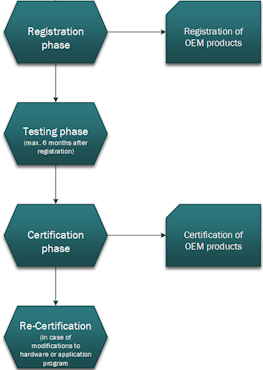
Registration Phase
1. Product Registration
Register the device in the KNX manufacturer portal. Provide full technical details. This includes hardware, software, functions, applications, and communication objects. Product certification requires referencing a valid stack certification and demonstrating stack compliance during the certification process.
Testing Phase
2. Pre-Testing Phase
Manufacturers should run pre-tests before formal certification. This involves:
- Internal testing with official KNX tools and specifications
- Protocol compliance verification
- Device behavior validation with KNX requirements
- Interoperability testing with reference devices
3. Laboratory Testing
Submit the device to an accredited KNX test laboratory. They verify:
- Protocol Testing: Correct implementation of KNX protocols
- Application Testing: Device functionality and parameters
- Interoperability Testing: Compatibility with other devices
- Documentation Review: Technical documentation accuracy
4. Test Evaluation
Laboratories evaluate device performance. They check for compliance violations and non-conformities. They provide detailed reports. If tests fail, they may recommend corrections.
Certification Phase
5. Approval and Certification
After passing all tests:
- The KNX Association approves the certification.
- The device receives KNX certification status.
- The manufacturer can use the KNX logo.
- The product appears in the KNX product database.
Stack Certification
Stack certification validates the core KNX protocol. It is independent of specific applications.
Purpose: Confirm the stack correctly implements KNX protocols and behaviors.
Testing Focus:
- Physical and data link layer compliance
- Network layer routing and addressing
- Transport layer segmentation and reassembly
- Application layer services and protocols
Benefits:
- Reduces testing effort for products using certified stacks
- Provides confidence in protocol implementation quality
- Accelerates time-to-market for new products
- Simplifies product certification process
Documentation: Manufacturers must keep stack certification results. They use these results for product certification to show the stack is compliant.
Product Certification
Product certification validates the complete device. This includes the stack and applications.
Scope: Testing covers the complete system:
- Stack implementation (may reference stack certification)
- Application behavior and parameters
- User interface and configuration tools
- Device integration capabilities
- Physical and electrical characteristics
Test Documentation: Comprehensive test reports include:
- Detailed test case results and measurements
- Protocol traces and communication logs
- Parameter validation results
- Interoperability test outcomes
- Non-conformity reports and resolutions
Certification Validity: Certified products must maintain compliance:
- Software updates may require re-testing
- Hardware changes require new certification
- Major functional changes trigger re-certification
- Minor updates may use simplified re-testing procedures