What is KNX IoT
Modern IP-based technologies like SPE T1S (Single Pair Ethernet) in control cabinets and Thread wireless mesh networks within rooms now enable new deployment options. These technologies challenge classic field bus systems in terms of interoperability, bandwidth, and cost. This evolution reflects the growing convergence of IT and OT (Information Technology and Operational Technology) in building automation. KNX IoT extends the traditional KNX system by utilizing modern IPv6-based Internet technologies based on IETF and IEEE standards. It addresses these market demands while maintaining KNX's proven interoperability and reliability.
KNX IoT contains three building blocks: KNX 3rd Party integration, KNX IoT Point API device interworking and a semantic project export/import for integration of KNX devices. These building blocks serve two distinct markets. In the B2B (Business to Business) market, installers, or integrators commission systems using commercially available tools like ETS. In the DIY (Do It Yourself) market, end customers configure and install devices themselves without professional installation services.
Horizontal Interworking among KNX Devices
Learn More About the Point API Stack
The section Point API Stack describes the KNX IoT device interface and communication stack.
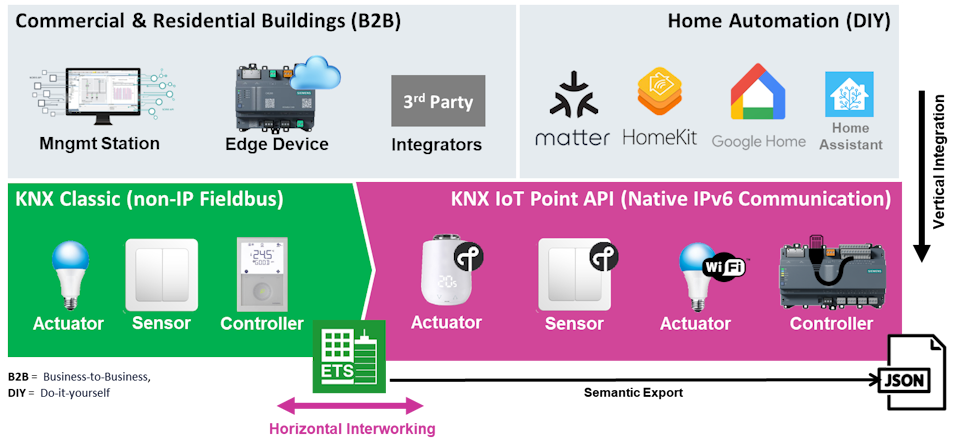
ETS is the common tool used by integrators and installers to configure both KNX classic devices and IP-based KNX IoT devices. With ETS, users can configure device applications, ensuring a smooth and intuitive user experience. Additionally, ETS enables seamless integration and interaction between classic devices and IoT devices, promoting horizontal interworking across the KNX system.
- Direct IPv6 communication between sensors and actuators for building automation applications like lighting, shading, HVAC, etc.
- Efficient group communication (S-Mode Messaging) between a sending device and a group of (one to many) recipients.
- Simplified semantic discovery based on data that reside in devices.
- Seamless interworking with KNX Classic.
KNX 3rd Party Vertical Integration
Learn More About the KNX IoT System
The section System Overview describes the KNX IoT system integration.
The overview illustrates the different building blocks, showing how KNX and non-KNX devices (whether B2B or DIY) integrate with a KNX system or individual devices. ETS configures KNX devices for horizontal interworking. ETS then generates a semantic export, which simplifies integration with non-KNX systems or devices.
- 3rd party (non-KNX) device or cloud service integration of KNX devices.
- Simplified semantic discovery based on data that reside in KNX IoT Point API devices.
- Data exchange utilizes client-server communication for read/write operations and pub/sub for asynchronous notifications in case of changes.
- The KNX semantic project export provided by ETS facilitates configuration and integration into 3rd party device or cloud service.
- KNX Classic: This refers to non-IP devices that commonly employ wired twisted pair cables for intercommunication.
- KNX IoT: This pertains to IPv6-based communication, utilizing various data link layers such as wired and wireless connections, all which support the IP protocol.
Semantic Project Export/Import for Vertical Integration
Learn More About the Information Model
The section Information Model describes the information model used for semantic project export and import.
System integrators can take advantage of the semantic project export provided by ETS to achieve seamless integration of a KNX system or device, ensuring smooth vertical integration. It is important to note that ETS is not directly used for the integration of KNX IoT devices. Instead, standard CoAP/OSCORE read/write and pub/sub requests accomplish the integration. This means that, for instance, an Edge Device or Controller is not required to be KNX certified or implement all the necessary KNX features, simplifying the integration process.
- Semantic project export/import includes linked data about location, devices, application functions and interdependency with the physical world (tagging) etc.
- ETS provides semantic project export/import as JSON-LD file based on manufacturer data and commissioning data.
- 3rd party clients can read/write/pub/sub Points w/o an additional ETS configuration step.