KNX IoT Certification Process
Overview
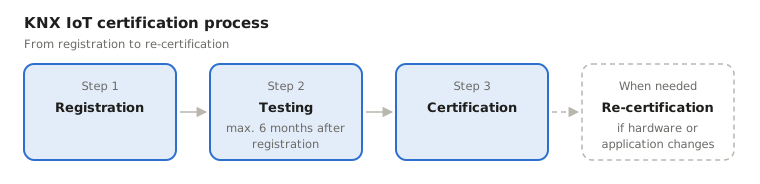
For more details, see the KNX IoT certification introduction.
KNX IoT device certification has two parts, just like other KNX products: a stack certification and an application certification.
- Stack certification covers the KNX IoT Point API stack, from the physical layer* up to the mandatory resources. Each combination of hardware platform, operating system and communication medium needs its own certification.
- Application certification covers the device application (such as a sensor or an actuator). Accredited KNX test labs verify it through interworking tests.
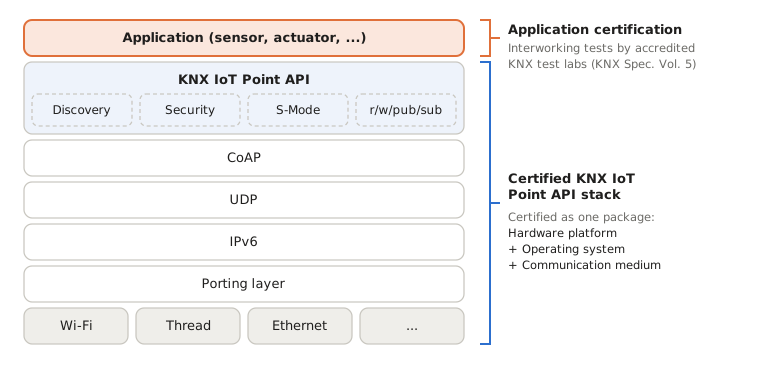
* The KNX IoT stack tests do not include separate physical layer tests. Stacks that support Thread must provide a Thread certificate.
Important
- A manufacturer completes the three phases (registration, testing, and certification) once for the stack certification and once for the application certification.
- A manufacturer that builds on an already certified stack only needs to certify its own application.
- The IoT End Device stack and the IoT Router stack are two different system components. Each one needs its own certification.
IoT Stack Certification
A KNX IoT stack porting certification covers one exact combination, and only the communication medium that the tests used:
Hardware Platform + Operating System + Communication Medium
For example, an ESP32 porting on FreeRTOS using Thread needs a separate certification from the same porting using Ethernet.
Each combination below is a separate certification. Every stack needs its own registration and must pass the certification tests.
| # | Hardware platform | Operating system | Communication medium |
|---|---|---|---|
| 1 | uC 1 | FreeRTOS | Thread |
| 2 | uC 1 | FreeRTOS | Ethernet |
| 3 | uC 2 | Zephyr | Thread |
| 4 | uC 2 | Zephyr | Ethernet |
| 5 | uC 1 | Bare metal | Thread |
| 6 | uC 2 | Linux | Thread |
These 6 combinations mean 6 separate stack registrations and 6 separate certifications.
"End Device Stack" certification tests
- The certification tests use EITT.
- For the IoT end device stack, create the tests with the "8/10/5-KNX IoT Point API Test" template.
- Until the end of 2027, the KNX Association performs the stack certification tests.
- Stack testing requires a dedicated test application running on the stack (see below).
Test application for stack testing
Stack testing needs a dedicated test application running on the stack. It must implement at least 2 functional blocks, 4 objects and 1 parameter.
| Functional block | Object | Resource type | Size | Direction | Interface type | Point path |
|---|---|---|---|---|---|---|
| FB 1 (fb.417) | obj 1 | dpa.417.61 | 1 bit | Input | if.i | /p/1 |
| FB 1 (fb.417) | obj 2 | dpa.417.62 | 1 bit | Output | if.o | /p/2 |
| FB 2 (fb.421) | obj 3 | dpa.421.61 | 1 bit | Output | if.o | /p/3 |
| FB 2 (fb.421) | obj 4 | dpa.421.62 | 1 bit | Input | if.i | /p/4 |
| Parameter | Resource type | Size | Point path |
|---|---|---|---|
| Parameter 1 | dpa.65500.201 | 1 byte | /p/p1 |
Resources
- EITT certification test application for the KNX open-source stack: knx-iot-point-api-demos
- How to run the EITT tests: EITT test documentation
- Running the certification template during development, without EITT: KNX IoT Point API Test Tool
"End Device Application" Certification Tests
The device application (such as a sensor or an actuator) sits on top of the certified stack and receives its certification through interworking tests.
- Accredited KNX test labs perform the interworking tests.
- Tests follow KNX Specifications Volume 5 (KNX Certification of Products).
- The application must use a certified KNX IoT Point API stack for its hardware, OS and medium combination.
"IoT Router" Certification Tests
System components, such as a KNX IoT Router, receive certification in one piece. They run a modified KNX IoT stack together with the dedicated application, so the certification tests cover stack and application as a single unit.
KNX IoT Router certification tests
- The certification tests use EITT.
- IoT Router EITT tests:
- IoT side tests: EITT test template "8/10/6-KNX IoT Point API Router Tests"
- KNX Classic side tests: EITT test template "8/10/6-KNX IoT Point API Router KNXnet/IP Tests"
- Supported DPT tests: the KNX Association must test all DPT main types that the device supports, including optional ones. EITT has no dedicated test template for these. The templates listed earlier cover the mandatory DPTs.
- Until the end of 2027, the KNX Association performs the IoT Router certification tests.
Certification by product type
| Product type | Example | Certification |
|---|---|---|
| End Device | Sensor, actuator | Stack certification* + application certification |
| System component | KNX IoT Router | Stack and application tested together as one unit* |
| *Until the end of 2027, the KNX Association performs these tests. |
IoT Product Certification Check List (End Device)
Q1: Do you have a certified IoT stack for the Hardware Platform + Operating System + Communication Medium combination you use?
- No: start from step 1.
- Yes: continue from step 4.
- Stack registration:
- For each stack combination (end device or IoT Router), fill in the registration form and send it to the KNX Certification department (ufuk.unal@knx.org).
- Stack certification tests:
- Prepare the stack test application (see Test application for stack testing).
- Run the EITT tests in-house, using the "8/10/5-KNX IoT Point API Test" template. If the tests pass:
- Contact the KNX Association to request the official certification tests.
- Send the hardware, with the stack and the certification test application on top, to the KNX Association in Brussels for the official certification tests.
- Issuing the stack certificate:
- If the tests pass, the stack certification is complete.
- Product registration:
- Complete the registration once the IoT product and its ETS product data are ready. For more information, see KNX product registration.
- Product interworking tests:
- Contact the test lab and send 2 devices. The devices must come from series production, with all markings and documentation ready (KNX Spec. Vol. 5).
- Issuing the product certificate:
- The product certification is complete once the test lab sends a positive test report to KNX.
IoT Product Certification Check List (IoT Router)
Registration, testing, and certification cover stack and application together as one unit.
- Registration:
- Fill in the registration form for the IoT Router and send it to the KNX Certification department (ufuk.unal@knx.org).
- Router certification tests:
- Run the EITT tests in-house:
- IoT side tests: EITT template "8/10/6-KNX IoT Point API Router Tests"
- KNX Classic side tests: EITT template "8/10/6-KNX IoT Point API Router KNXnet/IP Tests"
- Supported DPT tests: the KNX Association tests all DPT main types that the IoT Router supports, including optional ones. EITT has no dedicated template for these. The templates listed earlier cover the mandatory DPTs.
- Contact the KNX Association to request the official certification tests.
- Send 2 devices to the KNX Association in Brussels. The devices must come from series production, with all markings and documentation ready (KNX Spec. Vol. 5).
- Run the EITT tests in-house:
- Issuing the product certificate:
- The IoT Router certification is complete once the KNX Association has issued a positive test report.
Registration and Certification Fees
End Device
| Registration | Item | Fee |
|---|---|---|
| 1. Initial registration | Stack registration for one combination | €600 |
| Stack certification tests | Test lab fee* | |
| 2. Re-registration | Stack update (no hardware or OS change) | €30 |
| Re-testing | €125 per hour** | |
| 3. New products based on the registered stack | Hardware registration | €600 |
| Application registration | €180 | |
| Interworking tests | Test lab fee |
IoT Router
| Registration | Item | Fee |
|---|---|---|
| 1. Initial registration | IoT Router stack registration | €600 |
| IoT Router application registration | €180 | |
| IoT Router certification tests | Test lab fee* | |
| 2. Re-registration | Stack update (no hardware or OS change) | €30 |
| Re-testing | €125 per hour** |
* Until the end of 2027, the KNX Association performs these tests at a fixed price of €1,000.
** Until the end of 2027, the KNX Association performs the re-tests. The test fee depends on the number of hours spent on testing, at an hourly rate of €125.
For more details, see Registration fees and Testing fees.